Angle 3: Risk-Shield
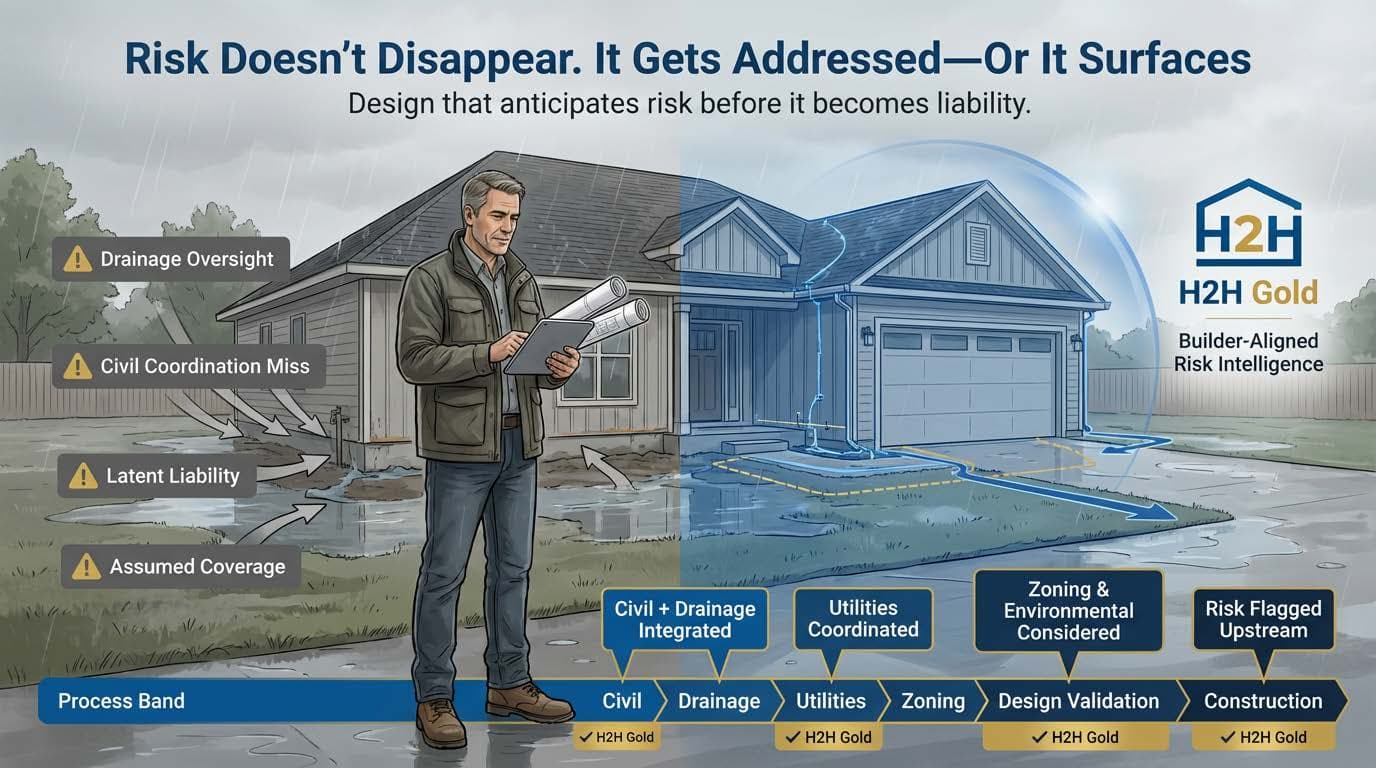
Architectural design should shield your build. Not expose it.
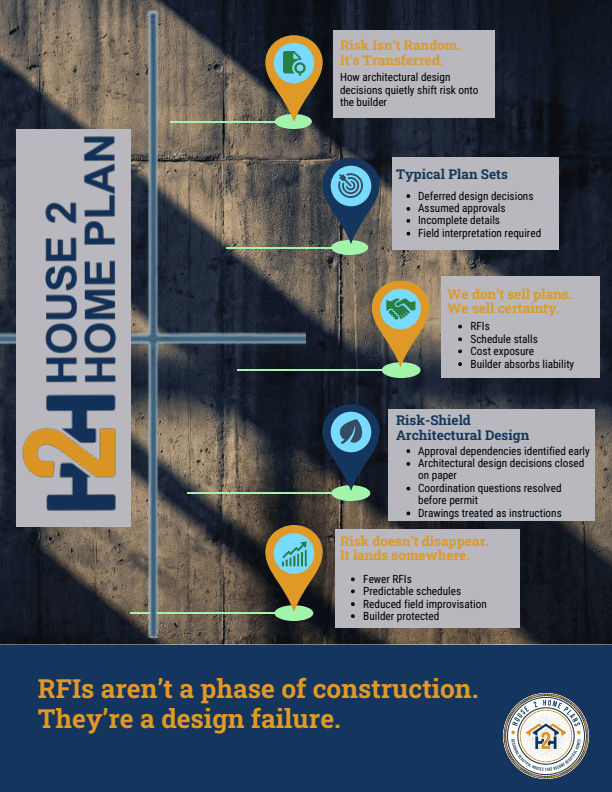
Most residential designers transfer risk downstream. We absorb it upstream by closing architectural design decisions before the field is forced to invent them.
Tired of residential designers who've never carried the risk telling you to 'figure it out in the field'?
We don't sell plans. We sell certainty.

The Invisible Transfer
Builders don't 'run into' risk. They inherit it.
When drawings defer decisions, assume approvals, or leave build-critical questions unanswered, risk compounds quietly until it lands on the builder as schedule pressure, cost exposure, and liability drift.
The Risk Accumulation Cycle
- 01Plans look complete but defer build-critical decisions.
- 02Review comments surface 'small clarifications' that aren't small.
- 03Framing or inspections stall while decisions are retrofitted.
- 04The builder eats the time, trades stack up, margin bleeds.
"Risk doesn't explode. It accumulates."
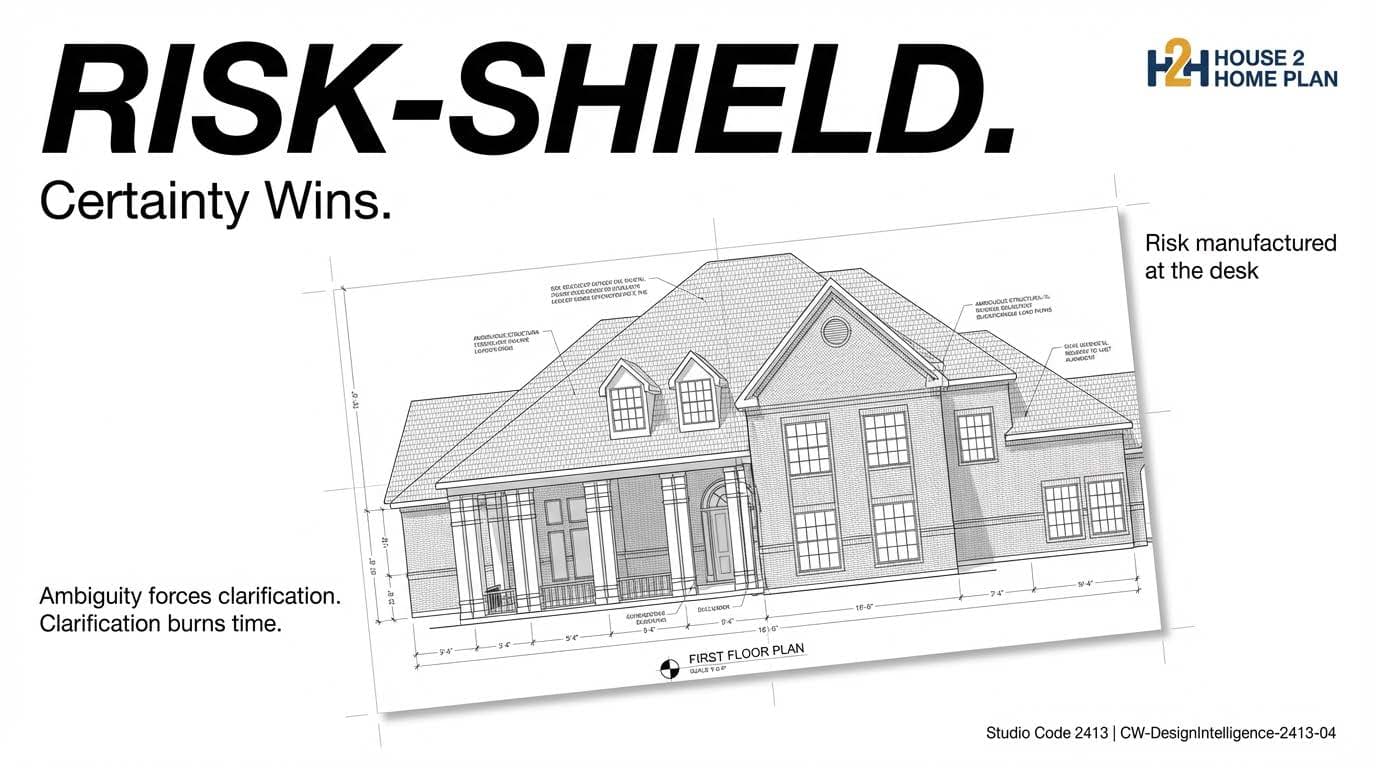
Most design firms transfer risk downstream.
The best ones absorb it upstream.
Approval Dependencies (Mapped Early)
We surface the approval chain early (jurisdiction constraints, HOA triggers, site-driven architectural design decisions) so you don't discover them after pricing and scheduling are locked.
Decision Closure (No Field Interpretation)
If the framer or inspector has to guess, the drawings failed. We close architectural design decisions on paper so the field executes instead of improvises.
Completeness (Permit-Ready Is a Test)
Permit-ready isn't a promise. It's proof of completeness: resolved dimensions, sections that answer questions, details that remove interpretation.
Scope reality: We do not provide civil, structural, or MEP engineering. We do own the architectural design decisions that create downstream collisions when left unresolved.
Watch: Where This Breaks Down (and Why It Matters)
[VIDEO INSERT – CERTAINTY WINS EXPLANATION]
A forensic look at how approval, coordination, and constructability risks originate at the desk, not the jobsite.
The Risk-Shield Methodology
Surface Approval Dependencies
We identify approval tripwires early (jurisdictional requirements, HOA constraints, site-driven architectural design decisions) so the plan set survives first contact with review.
Close Coordination Loops
We resolve architectural design interfaces that typically trigger RFIs (alignment points, envelope transitions, sequencing conflicts) before the field hits them.
Remove Interpretive Burden
Drawings are instructions. When a crew has to interpret intent, risk transfers to the builder. We remove the guesswork.
Reduce RFI Volume
We answer build-critical questions upstream so RFIs don't become a hidden scheduling system.
Primary Identity
Campaign Seal
Who This Is For
- •Custom home builders who want predictable schedules and fewer 'surprise' clarifications.
- •Builders who value architectural design certainty over raw speed.
- •Builders tired of absorbing invisible risk from incomplete plans.
Who This Is Not For
- •Anyone comfortable treating RFIs as normal workflow.
- •Anyone who treats RFIs as a normal part of the process.
- •Anyone who confuses completeness with decoration.